Hi!
Just thought I would write something about the pedal board I am using as of 2020:
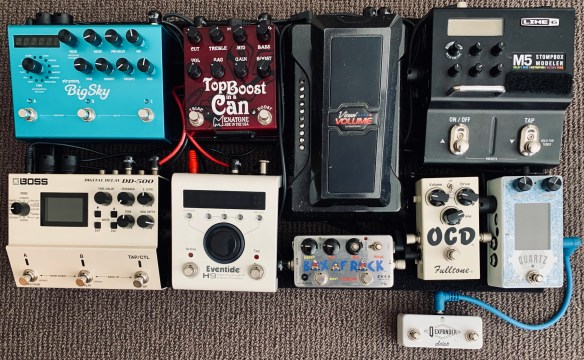
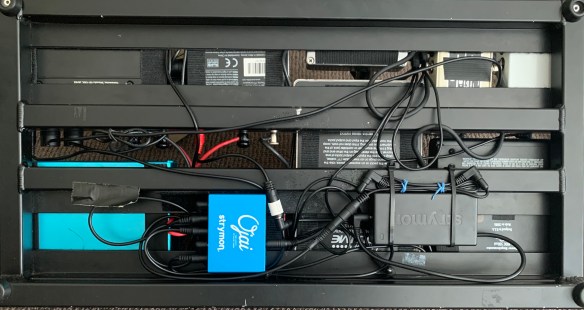
It contains the following:
Line 6 M5 Stompbox Modeler -> Fulltone OCD v1.7 -> Zvex Box of Rock (BOR) -> Menatone Top-Boost-In-A-Can (TBIAC) -> Visual Sound Visual Volume (VV-10) -> Eventide H9 Max -> Boss DD-500 Digital Delay -> Strymon BigSky Reverb.
Selah Quartz V2 is being used to send out global tempo and MIDI messages to the H9, DD-500, BigSky and M5. The Q:Expander is used to bank up/down presets and toggle program changes to the M5. All these devices are connected using One Control MIDI patch cables. A TRS cable (from SWAMP Industries) connects the Q:Expander to Quartz.
All pedals are powered by a Strymon Ojai mounted under the board (Pedal Train PT-2). A Strymon Polarity Reversal Cable is used for the Eventide H9 and a Truetone 1-Spot Multi Plug to daisy chain the OCD, BOR, TBIAC, VV-10 and Quartz. I use a combination of George L and Lava Cable patch leads which have been serving me well for 10+ years.
I have been using Line 6 M5 as a kind of ‘Swiss Army Knife’ of gain and compression that I control using MIDI. I am particularly fond of the “Boost Comp” model it offers which is inspired by the MXR Micro Amp and contains parameters for Gain, Treble, Bass, Compression & Volume. This is general left ‘always on’. In addition to this, I generally leave the “Distortron” side of my Z-Vex Box of Rock ‘always on’ a light gain setting as a sort of pre-amp and add extra body to my sound.
I have been using Eventide H9 for its vast array of algorithms of which I like can call upon and experiment with as needed. I really love the sounds you can get out of this device! I also use it as a tuner (easily accessed by simultaneously holding “Active” & “Tap”).
The DD-500 covers the vast majority all of my delay sounds. There are times when I make use of the H9’s delays and the BigSky’s “Magneto” setting for alternate sounds and textures.
The Strymon BigSky covers most of my reverb sounds. I have found great use of its “cab filter” for recording purposes and running direct-in to the sound desk for live scenarios where excess amp noise needs to be mitigated.

 Tom Warren